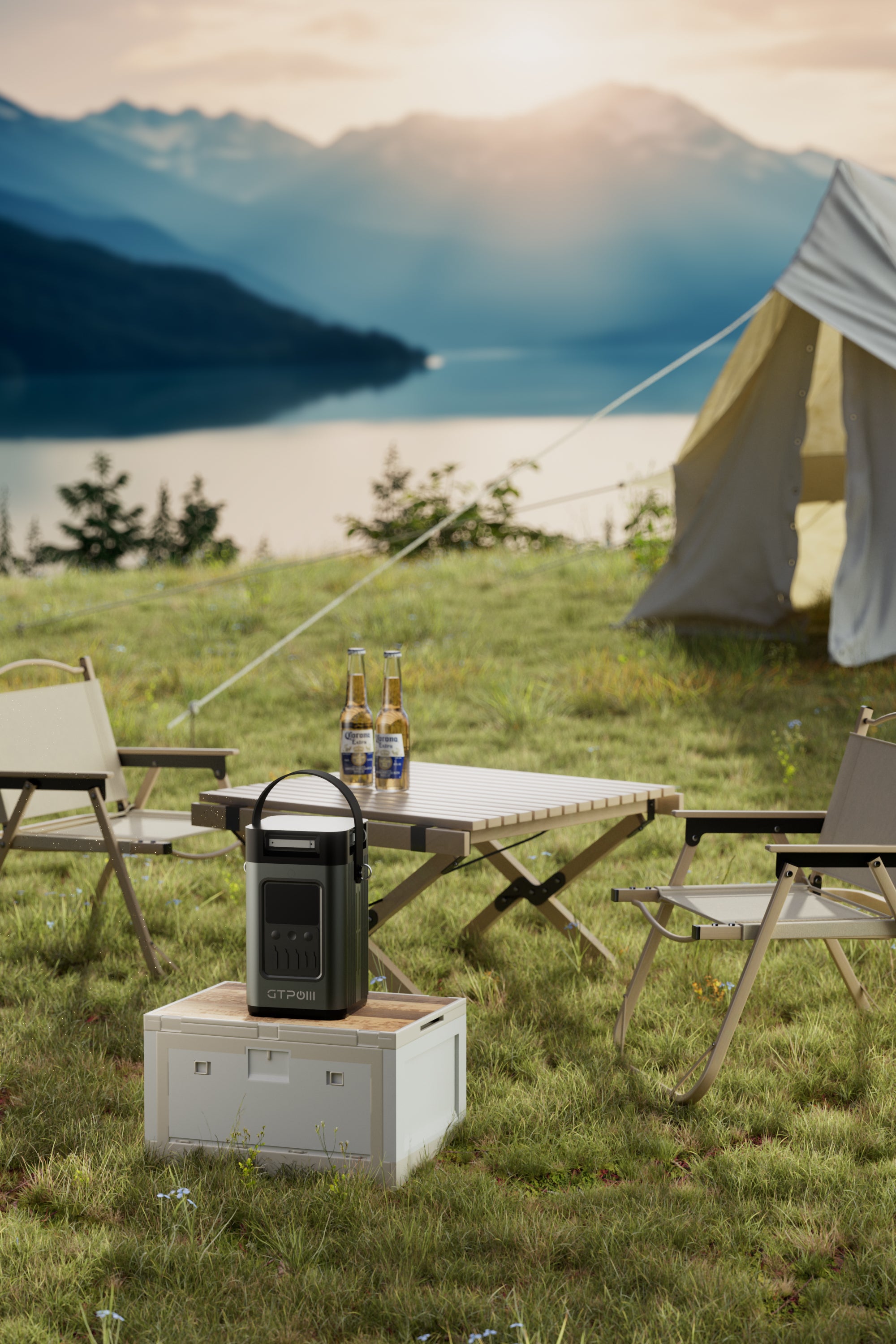
Small Power Station vs. Power Banks: Which Is Better for Camping?
You’re packing for a weekend away. Your phone needs charging, the camera needs a backup battery, and you’d like some light around camp after dinner.
Do you bring a couple of power banks and a lantern—or one small power station that handles both?
Either can work. The better choice depends on how much energy you need, how far you’ll carry it, and whether combining charging and lighting actually makes camp easier.
What Are You Comparing?
For this comparison, a small power station means a compact camping battery with built-in lighting and multiple charging outputs.
Features vary. Some models have AC outlets; others only offer USB or DC connections. A built-in floodlight, spotlight, or flashing signal mode is a model-specific feature, not something every power station includes.
Power banks vary too. Some have multiple fast-charging ports, large batteries, or built-in lights.
Look at what the device provides—not just whether the label says “power bank” or “power station.”
Where Power Banks Still Make Sense
Power banks are easy to pack, easy to share, and useful well beyond camping.
For a short trip with modest phone use, one may be all you need. If you already own a rechargeable headlamp, adding a separate lighting system might solve a problem you don’t have.
Multiple banks also give you flexibility. One person can take a bank on a walk while another keeps one at the tent. You don’t need everyone’s devices gathered around a single charging point.
There’s some redundancy, too. If one bank runs out or fails, the others remain available.
The downside is keeping track of several battery levels. For families charging around the same table, that can feel less convenient than one central unit.
Where a Small Power Station Helps
A compact station with a useful built-in light can simplify a settled campsite.
Place it on a table, connect your devices, and use its light while cooking or sorting gear. If it replaces a lantern and separate batteries you would otherwise carry, the integration earns its place.
But check the arrangement before assuming it works.
Can the light illuminate the table without shining into everyone’s eyes? Can you hang it safely? Will connected phones have somewhere secure to sit?
The light needs to be in the right place—not merely built into the battery.
Keep a separate headlamp for walking to the bathroom, finding equipment, or dealing with a flat battery. A shared camp light isn’t a replacement for personal lighting.
Compare Energy, Not Just mAh
A 40,000mAh small power station rating is a useful specification, but it doesn’t tell the whole story.
Capacity comparisons only make sense when the stated voltage matches. Watt-hours, or Wh, provide a clearer way to compare stored energy across products. Some energy is also lost during charging, so the full rated capacity won’t reach your devices.
Then check the outputs:
Does each port support the charging speed your devices need?
What happens when several ports are used together?
How much battery will the built-in light consume during an evening?
More sockets do not mean unlimited charging power. And a larger battery does not automatically mean faster charging.
Which Fits Your Camping Style?
These situations offer a better guide than declaring one device the winner.
|
Your Trip |
What Usually Makes Sense |
|
Day hike or lightweight overnight |
A power bank matched to your needs, plus a headlamp |
|
Car camping around one shared table |
A small station may simplify charging and lighting |
|
People splitting into separate groups |
Individual power banks offer more flexibility |
|
Evening fishing |
Check light placement, runtime, and weather protection |
|
Short outage at home |
Either can support phones; integrated lighting adds convenience |
For emergency use, keep expectations realistic. A compact battery suitable for phones and lighting may not run household appliances.
Does Combining Gear Save Weight and Space?
Sometimes—but weigh the complete setups.
Compare the station against the batteries and lantern it would genuinely replace. If you were only taking one power bank and a lightweight headlamp, the station may add bulk rather than reduce it.
For scale, a 40,000mAh station typically weighs 1–1.5kg. A 20,000mAh power bank plus a lantern and a headlamp weighs around 500–700g. The station is heavier—but you get more capacity and fewer items to manage.
You’ll still need charging cables for your devices. A central unit can tidy the setup, but it doesn’t make those connections disappear.
Shape matters as well. Several slim power banks may fit into spare pockets more easily than one chunky unit. At a car campsite, that may matter less than having everything in one place.
Before You Buy
First, check what you already own. A power bank and headlamp may cover the trip without another purchase.
If you’re considering a station, check its weight, usable outputs, lighting runtime, and weather protection. Confirm whether the protection includes the ports or requires covers to be closed.
For models with an SOS flashing mode, treat it as a visual signal—not a substitute for a phone, satellite communicator, or emergency plan.
Also check the operating temperature range. Many lithium batteries cannot charge below freezing, which matters for cold-weather camping.
The Better Choice Is the One You’ll Use Well
Choose power banks when low weight, flexible packing, and separate charging matter most.
Choose a small power station with built-in lighting when you want a shared charging spot and can genuinely replace another item in your kit.
Combining functions is useful when it simplifies your routine—not simply when it makes the feature list longer.